 PRODUCT CATEGORIES PRODUCT CATEGORIES 
# 1. The Finest Sensor Technology
# 2. Continuous Data from Cabled Sensors # 3. The ULTIMETER PRO Anemometer/Wind Vane # 4. WeatherText Serial Data Output # 5. APRS Ready # 6. Price and Value # 7. The Weather Picture # 8. Long-Term Support Commitment # 9. Live telephone Customer Service/Tech Support #10. Made in USA |
|
Ten Best Reasons >
# 3. The ULTIMETER PRO Anemometer/Wind Vane
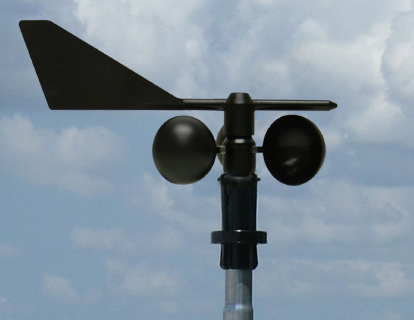
The ULTIMETER® PRO Anemometer features exceptional response in all wind conditions, including very low wind speeds (typical starting threshold 1.5 mph! here's why - comparison chart). The ULTIMETER® PRO Anemometer/Wind Vane ("wind sensor") is a patented, uniquely all-digital design containing two magnetic switches. Unlike conventional wind sensors, the ULTIMETER®PRO Anemometer's patented digital design has no potentiometer or other friction contacts to wear out. It features bearings that are virtually corrosion proof, with self-lubricating Delrin® races and surgical steel balls. The precision-molded housing of UV-resistant Lexan® will resist the harshest elements for many years.
THE BEST WIND SENSOR IN ITS CLASS
HOW DOES IT WORK?
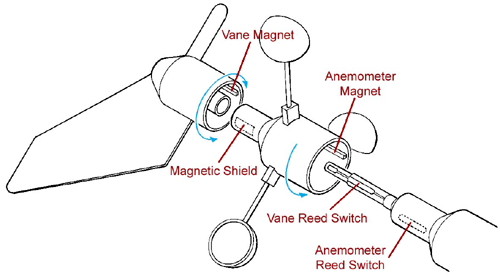
The ULTIMETER Anemometer/Wind Vane ("wind sensor") is a patented, uniquely all-digital design containing two magnetic switches. Each switch opens and closes once each time the cups go around. Wind speed is calculated by measuring the time between consecutive pulses from one switch. Wind direction is determined by measuring the relative timing between pulses from the two switches. North is indicated when the two sets of pulses exactly coincide. South is indicated when pulses from one switch occur exactly midway between consecutive pulses from the other switch. Unlike other manufacturers' anemometers, the ULTIMETER does not use a potentiometer for determining wind direction, with its inherent drawbacks of high friction and mechanical wear (using a potentiometer for wind direction is kind of like someone playing with the volume knob on your radio, non-stop).
Here's how our superbly reliable wind sensor works: A reed switch is a long-lived, hermetically sealed switch that actuates when a magnet is brought near it. The anemometer reed switch is normally open, whereas the centered vane reed switch is normally held closed by the strong vane magnet, regardless of wind direction. During each revolution of the cups:
• The anemometer reed switch closes briefly as the anemometer magnet approaches, then reopens when the anemometer magnet has passed. This actuation always occurs at the same angular position of the cups. • The vane reed switch opens briefly, then closes again as the magnetic shield passes between it and the vane magnet, absorbing the magnetic field. The timing of the vane reed switch is determined by the angular position of the vane magnet, which is in turn determined by wind direction. Wind direction is calculated (with a resolution of 1.4 degrees) by comparing the relative timing between operation of the two reed switches. "Keep a weather eye on Peet Bros." |
|
|



;)